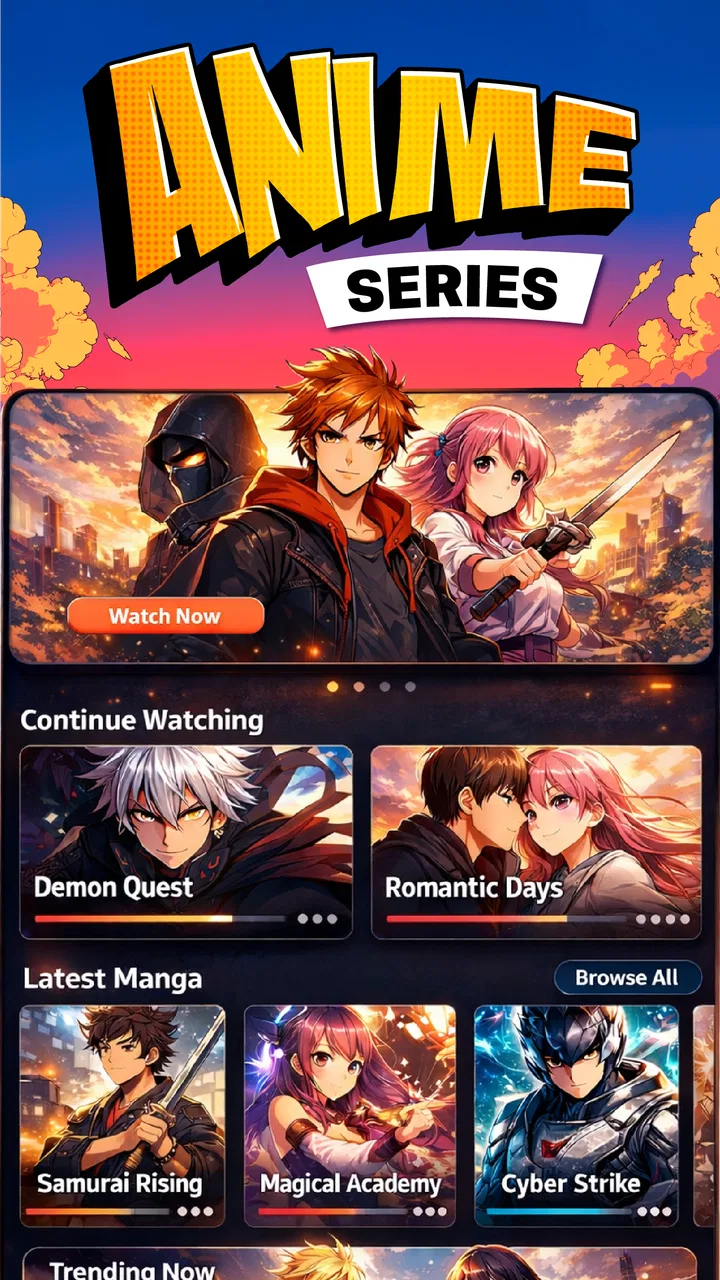
Anime App - Watch Anime Series
- 4.6
- Rating
- 500.00K
- Installs
- Free
- Price

 Analysis by App-foxy
I approached Watch Anime Series Online as a viewer who wanted a simple way to move between manga reading and anime watching without treating the phone like a complicated media center. The app belongs to the Comics category, is free to install, and comes from Rstream Labs. Its basic promise is appealing: one place for manga stories and anime entertainment rather than separate apps for every kind of Japanese-inspired content.
My first impression was that the app makes more sense for casual browsing than for someone who already has a carefully organized library. I could open it when I had a few spare minutes, look for something interesting, and switch from reading to watching without much planning. That flexibility is its strongest idea, but it also creates the main challenge: an app covering two related forms of entertainment can feel less focused than a dedicated manga reader or a specialized anime service.
The current version is 3.0.550, and the app supports devices running Android 7.0 or later. That broad compatibility makes it practical for people using older phones, although the quality of the experience still depends on the device, connection, and how smoothly the particular content loads. It carries a Teen content rating, so I would not treat it as a children’s entertainment app without checking what younger viewers are accessing.
You May Also Like

 Blood Strike: 2.5 Anniversary
Blood Strike’s Loadouts Turn Every Drop Into a Tactical Gamble
A close look at Blood Strike’s custom loadouts: how fast access to signature weapons reshapes its battle royale rhythm, rewards preparation, and narrows the gap between fights.

 Pandora - Music & Podcasts
Pandora’s Music Is Easy to Start, but Harder to Recover
Pandora’s strength is its low-effort path from a seed to a station. Its weak spot is how much confidence it asks you to place in connection, setup, and quiet recovery.

 8 Ball Pool
 Is Built on Rivalries, Rematches, and Routine
A close look at the rivalries, rematches, shared routines, and unanswered safety questions that turn a quick pool match into a persistent mobile community.

 Samsung Music
’s Quiet Strength Is Playing What You Already Own
Its reach comes less from spectacle than from dependable access to a personal library. That simplicity is both the app’s strongest retention engine and its ceiling.

 AccuWeather: Weather Radar
AccuWeather Review: A Quick, Clear Forecast for Everyday Decisions
For everyday plans, the best forecast is the one you can understand quickly. AccuWeather makes rain timing, radar, and local conditions easy to act on, with a few trade-offs.

 Hill Climb Racing
Why Hill Climb Racing Still Turns Crashes Into One More Run
A tiny car, a bumpy hill and one more upgrade: Hill Climb Racing keeps resurfacing because its simple chaos makes every near-miss feel personal.
More From Our News Desk
View All News


Getting past the first points of friction
The place where I would expect many new users to hesitate is immediately after opening the app: should they start with manga or anime? The store summary presents both, while the short description focuses on watching anime. That difference matters because someone installing it for reading may expect the reading side to be the main experience, while a viewer looking for series may want to reach playback as quickly as possible.
I found it more useful to decide on a purpose before exploring. If I had only ten minutes, I looked for a short reading session rather than beginning a series I could not finish. If I wanted a longer evening activity, I treated the anime area as the starting point. This small habit reduces aimless scrolling and helps reveal whether the app actually fits your routine instead of judging it after a few random taps.
Another likely sticking point is the difference between discovering content and consuming it. A catalog can look inviting while still requiring patience to find something that matches a particular mood. I would not install this expecting the same depth of filtering, library management, or specialized reading controls that a dedicated service may provide. Its value is the combination of formats, not necessarily the most refined tools for one format alone.
There is also a financial detail worth noticing before settling in. The app is free, but it includes in-app purchases ranging from $0.49 to $59.99 per item. I would therefore explore the free experience first and avoid assuming that every part of the catalog follows the same access model. If you are handing the phone to a teenager, it is sensible to review purchase controls on the device before regular use. The Teen rating and the optional spending make that preparation more important than it might be with a basic offline comic reader.
What I check before blaming the app
When a title does not open or a video does not begin, I start with simple checks rather than concluding that the service is broken. I confirm that the phone has a working connection, especially if other apps have also been slow. I then close and reopen the app, because a temporary loading state can survive longer than expected when the application has been left in the background.
I also check whether the problem affects one item or everything. A single title failing points me toward a content-specific or temporary loading issue, while a completely empty screen suggests a broader connection or application problem. This distinction saves time. Reinstalling immediately is rarely my first choice, particularly if I have not yet established whether the same network problem affects other services.
On an older device, I pay attention to available storage and background activity. Even though the minimum operating system is Android 7.0, compatibility does not guarantee an equally smooth experience on every phone. A device with little free space, many open apps, or an aging battery may struggle more with video playback than with reading pages. Closing unused apps and restarting the phone are ordinary steps, but they are useful here because they separate general device strain from an issue specific to this app.
I would also keep the app updated when an update is available through the normal store process. The version number identifies the build I reviewed, but performance can change as the application develops. If a problem begins after an update, noting exactly when it started is more useful than describing it simply as “the app does not work.” That detail helps you decide whether to wait, retry later, or use another way to watch.
A calmer recovery workflow for stalled reading or playback
My recovery routine is deliberately short. First, I leave the title and try another item. Second, I close the app fully and reopen it. Third, I test the connection with a different app or website. Fourth, I restart the phone if the whole device feels sluggish. Only after those steps would I consider reinstalling, and I would do that knowing that any local session state may need to be established again.
This workflow is especially helpful when browsing works but playback does not. In that situation, the catalog and the video request may be behaving differently. I avoid repeatedly tapping the play control because multiple requests can make the screen look more confused rather than fixing the original delay. Waiting briefly after one attempt gives me a clearer signal about whether the issue is temporary.
For reading, I use a different test: I open another chapter or story instead of repeatedly refreshing the same page. If other pages appear normally, the problem may be limited to that item or moment. If nothing loads, I return to the connection and device checks. The distinction is practical because it prevents a single failed page from ruining the entire session.
I would not promise that every interruption can be solved locally. A streaming app depends on more than the phone, and a reader cannot repair a remote availability problem from the settings screen. The useful goal is not to force a fix at any cost; it is to identify whether retrying later is sensible or whether another service is the better choice for that evening.
When the phone, network, or expectations are the real issue
Sometimes the app receives the blame for a weak home connection, crowded public Wi-Fi, or a mobile signal that changes while travelling. Video exposes those weaknesses quickly, while text and images may continue to load. If manga pages open but anime playback keeps stopping, I would test the connection in a different location before changing the app itself.
Screen size also affects the verdict. A phone is convenient for a quick chapter or an episode while commuting, but long reading sessions can feel cramped, particularly if you prefer large panels and comfortable spacing. Someone who mainly reads manga at home may be happier with a tablet or a dedicated reader designed around page navigation. I see this app as more flexible than specialized, so the device you use becomes part of the experience.
The same applies to data use. I would be cautious about watching anime over mobile data unless I already understand my plan and the app’s behavior on that connection. A short test is wiser than starting a long session away from Wi-Fi. This is not a criticism unique to the app; it is a normal trade-off of streaming video, but it matters when the app encourages switching casually between reading and watching.
Content expectations can create another mismatch. The app’s broad entertainment focus may suit someone who enjoys discovering stories, but a fan searching for a specific title, a particular language option, or a highly structured collection may prefer a service built around that exact need. I would not choose it solely because the words “anime” and “manga” appear together. I would choose it if the combined format is more valuable to me than deep specialization.
How I would use it in an ordinary day
Imagine a weekday evening when I have a short break before dinner. I open the app intending to read, browse a story, and stop after a few pages. Later, if I have more time, I return to explore the anime side. That pattern makes the app useful because the same installation supports two different moods: active reading when I want control over the pace, and viewing when I would rather relax and let the story play.
For that routine, I would keep my expectations modest and use the app as an entertainment shelf rather than a complete personal archive. I would remember the titles I enjoy, but I would not assume that every session will resume exactly as I imagine or that every discovery will become a long-term favorite. The app works best when I am open to browsing and willing to move on if one item is inconvenient.
A second practical use is helping a new anime fan sample the wider culture around a series. Reading manga and watching anime can feel different even when they share a style, and having both formats nearby makes comparison easy. I can read when I want to control the pace and watch when I want a more passive experience. That is a genuine advantage over installing only a single-purpose reader.
On the other hand, I would skip it for a child’s unsupervised viewing, for a household that needs tightly managed spending, or for someone whose priority is a polished, highly organized collection. The Teen rating is a clear reminder that the intended audience is not very young children. I would also choose a dedicated alternative if offline access, advanced reading customization, or a precise catalog is essential to my decision.
Where it stands beside the usual alternatives
Compared with a dedicated manga reader, this app’s attraction is variety. I do not need to decide in advance whether I am a reader or a viewer. The compromise is that a specialist may feel more comfortable for long reading sessions, especially if its navigation and library tools are built around panels, chapters, and personal organization.
Compared with a specialist anime platform, the app offers a more mixed experience. That can be convenient for casual users who do not want separate applications, but a focused streaming service may be preferable when episode discovery, viewing continuity, or a large structured catalog matters more than having manga nearby. I would make that choice based on how often I switch formats, not on the number of features listed on a store page.
There is also a difference between browsing and collecting. A person who wants to build a carefully labeled library may find a general entertainment app less satisfying than a tool designed around ownership or subscription management. I use this one more like a doorway to stories than a permanent filing cabinet. That distinction is important because it explains why I can enjoy it while still preferring another app for serious organization.
Who will enjoy it, and who should pass
I think the best match is a casual anime and manga fan who wants one free starting point, enjoys discovering material, and does not mind that the experience may be broader than it is specialized. It is also suitable for someone with an older Android phone that meets the Android 7.0 requirement, provided the device and connection are in reasonable condition.
I would be more cautious if you need a completely predictable cost. The free entry is attractive, but the presence of purchases from $0.49 to $59.99 per item means I would inspect any purchase prompt carefully. Families should set device-level safeguards, and individual users should avoid treating “free” as a guarantee that every possible item or convenience follows the same model.
The audience rating deserves equal attention. A Teen classification makes it a better fit for teenagers and adults than for young children, and parents should remain involved in choosing what is watched or read. That is a practical part of deciding whether to install it, not a minor footnote.
Rstream Labs has built an app with a clear everyday use case: combine manga discovery and anime viewing in a single place. Its average rating is 4.4 from around 10K ratings, and it has passed 500K installs, which suggests that the concept has found a substantial audience. I treat those figures as signs of interest rather than proof that every device or viewing habit will suit it.
My practical verdict after using it
Watch Anime Series Online is worth trying if you want a low-commitment way to move between comics and anime. I like the format switch because it matches how I actually use entertainment apps: sometimes I want to read at my own speed, and sometimes I want to watch without making a separate decision about which service to open.
Its limitations are just as clear. Setup and playback problems may come from the connection or phone rather than the app, and the mixed focus cannot replace every advantage of a dedicated manga reader or anime platform. The free installation is a good reason to test it, but the in-app purchase range means I would stay attentive to access and spending prompts.
My recommendation is to install it, test both sides on your usual device, and judge it through a normal short session rather than an idealized browsing tour. Check how quickly you reach the content you want, how your connection handles viewing, and whether the Teen rating suits everyone who may use the phone. If those checks go well, this is a convenient entertainment companion. If you need deep organization, tightly controlled access, or a specialist experience, I would choose a more focused alternative instead.
FAQs for Anime App - Watch Anime Series
01Is the app free to use?
The app offers a free version with limited access to certain anime series and features. However, for a more comprehensive experience, including access to the latest releases and ad-free streaming, a premium subscription is available. Pricing details can be found within the app’s purchase options.
02What devices are compatible with the app?
The app is compatible with both Android and iOS devices. It supports a wide range of smartphones and tablets running Android version 5.0 or later, and iOS version 11.0 or later. Ensure that your device meets these requirements for optimal performance.
03Can I download episodes to watch offline?
Yes, the app allows you to download episodes for offline viewing. This feature is particularly useful for users who want to watch anime series on the go without relying on a stable internet connection. Note that offline downloads may be limited to certain subscription tiers.
04Does the app offer subtitles and dubbing options?
The app provides a variety of subtitle options in multiple languages, catering to a global audience. Additionally, several popular series offer dubbed versions in English and other languages. Users can easily switch between subtitles and dubbing in the settings menu.
05How frequently is the anime library updated?
The anime library is updated regularly, with new episodes and series added frequently to keep up with current releases. Users can expect updates on a weekly basis, ensuring access to the latest episodes soon after their original broadcast. Check the app’s update section for the latest additions.
Pros
- Wide variety of anime titles available.
- High-quality streaming with minimal buffering.
- User-friendly interface for easy navigation.
- Regular updates with new episodes.
- Option to create personalized watchlists.
Cons
- Contains ads that may interrupt viewing.
- Limited offline viewing options.
- Some series may lack subtitles.
- Requires a stable internet connection.
- Not all content is available globally.

Anime App - Watch Anime Series
Gallery